RF Intermediate
Smith Charts, matching networks, transmission lines, and impedance transformation techniques.
Smith Chart Fundamentals
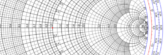
What does the Smith Chart represent, and why is it preferred over a Cartesian (R+jX) plot?
It is preferred because movements along transmission lines become simple rotations, and adding series/shunt components become arc movements along constant-resistance or constant-conductance circles.
How does a series LC look on a Smith Chart?
Together, a series LC traces an arc up then back down (or vice versa) along a constant-R circle, with the extent depending on frequency and component values.
How does a pi CLC network look on the Smith Chart?
- A shunt C moves along a constant-conductance circle on the admittance chart
- A series L moves along a constant-resistance circle on the impedance chart
- Another shunt C on the admittance chart
The trajectory traces a path that can take you from one impedance to another through these three arc movements.
I only have L and C — can I control the bandwidth of a tank circuit using different LC values?
f = 1/(2π√LC), so multiple LC combinations can hit the same frequency. However, the Q-factor (and thus bandwidth) depends on the L/C ratio and parasitic resistances.
- Higher L, lower C: Higher impedance at resonance → narrower bandwidth (higher Q)
- Lower L, higher C: Lower impedance at resonance → wider bandwidth (lower Q)
So you can control bandwidth by adjusting the L/C ratio while keeping the product LC constant.
What does a lossless transmission line look like vs. frequency on a Smith Chart?
What if the transmission line is not lossless?
Impedance Matching & Transformers
What is a quarter-wavelength transformer? Formula to convert 100Ω to 50Ω?
So a 70.7Ω quarter-wave line will transform a 100Ω load to 50Ω.
How does the 100Ω to 50Ω quarter-wavelength transformer look on a Smith Chart?
Matching network Q circles on the Smith Chart?
Q = |X|/R. They appear as arcs passing through the center of the chart.
- Higher-Q circles are closer to the outer rim (reactive axis) → narrower bandwidth
- Lower-Q circles are closer to the center → wider bandwidth
When designing matching networks, staying inside a particular Q circle ensures the network’s bandwidth meets the specification.
Transmission Line Properties
How does the width of a transmission line change when you increase the dielectric thickness? Why?
What is the effect of temperature on permittivity? Why?
- Linear Dielectrics: Permittivity may slightly increase with temperature due to enhanced ionic and electronic polarization, but the change is generally small.
- Dipolar Dielectrics: Permittivity typically decreases with increasing temperature. Thermal agitation reduces dipole alignment, lowering the dielectric constant.
- Phase Transitions: Some materials (e.g., ferroelectrics) exhibit a peak in permittivity at their Curie temperature, beyond which permittivity sharply decreases as they transition from ferroelectric to paraelectric phase.
What does an open-ended bowtie stub do when connected to a transmission line?
Why does the Smith Chart S11 rotate clockwise with frequency?
From group delay: Passive networks are causal systems — the output cannot arrive before the input. This means they must have a positive group delay (τ_g = −dφ/dω > 0), which requires the phase to be a decreasing function of frequency. On the Smith Chart, decreasing phase with increasing frequency corresponds to clockwise rotation. The clockwise direction is a fundamental consequence of causality in passive networks.